News

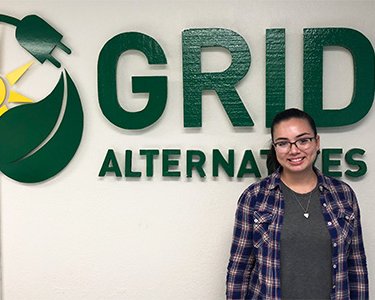
My name is Jisela Herrera and I am a fourth-year student at the University of California, Riverside. Science has always been a passion of mine and more specifically, environmental science. I knew I wanted to intern at an organization where I could make a positive impact in people’s lives and the future of our planet. As someone who is deeply passionate about social justice and environmentalism, I found GRID Alternatives to be the perfect internship for me as it has given me the opportunity to contribute to the environment and society in a much broader spectrum. The first thing that attracted me to GRID Alternatives was their mission statement. GRID Alternatives installs solar systems at no cost to low-income homeowners and I knew from the start that I wanted to partner up with an organization with integrity, which I found here at GRID.
Roger Stark was born and raised in Ohio. At 18 years old and fed up with harsh Ohio winters, Roger trekked across the nation, finding himself in sunny San Diego where he was recruited as a Marine. He served during the Vietnam era for three years. He was filled with excitement when he first enlisted, learning quickly what serving this country means – leadership, teamwork, reliability and community service.
GRID Alternatives provides career exploration and solar education to K-14 students through its Solar Futures program. The curriculum provided through Solar Futures inspires young students to become the next generation of solar leaders. It also offers the opportunity to get hands-on experience in a field that is growing by 20 percent each year. Over 600 students have already been trained through this program, and approximately 65 solar projects have been built for Inland Empire’s disadvantaged communities as a result of these students efforts.
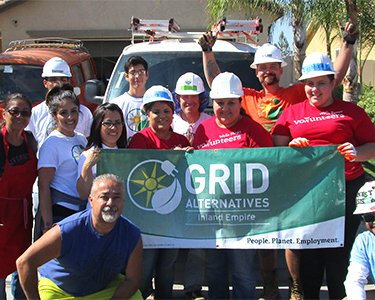
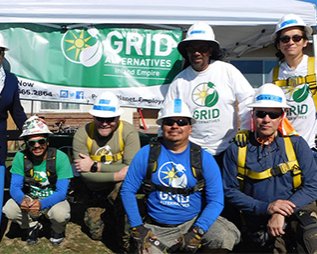
Jurupa Valley High School students built upon their solar installation skills as they participated in a Solar Futures event in Jurupa Valley. The students have been learning about renewable energy in their classrooms and GRID’s installation was an opportunity for students to put what they have learned to the test. Students participated in all aspects of the install including rack assembly, electrical wiring and rooftop assembly of a 5.1 kW solar system.
The Solar industry had the second largest quarter in US History based on a recent report from the Solar Energy Industries Association (SEIA) — installing over 2.3 gigawatts of solar PV — and is expected to grow to 12 gigawatts of solar capacity by the end of 2017. GRID Alternatives contributed to this growth as the largest nonprofit solar organization in the industry, with nearly 1,200 systems installed in 2017. GRID is also an innovative industry leader through the development of our Multifamily Affordable Solar Program. Our teams assist developers and governmental agencies in providing renewable energy solutions to individuals who live in multifamily structures such as apartment complexes.
GRID IE is approaching an important milestone in October as a 90 kW microgrid system will be installed at the Chemehuevi Indian Tribe’s Community Center in Havasu Lake, California. The microgrid represents another successful project that has already seen the GRID-Chemehuevi partnership blossom with over 80 residential solar systems installed on tribal homes. The partnership has also produced a Solar Spring Break with Duke University and provided photovoltaic (PV) training for over 20 tribal members.
Do you know someone who is considering changing careers? If so, one of the fastest growing segments of the Inland Empire economy is solar. According a study commissioned by Next 10 and reported by the Riverside Press Enterprise, state climate policies have driven $9 billion in direct economic benefits and supported 41,000 jobs in the Inland Empire over the last seven years. The demand continues for skilled workers as there are currently over 80 positions for solar related jobs open in the Inland Empire.