
Community-driven solutions for affordable public and multifamily on-site electric vehicle charging
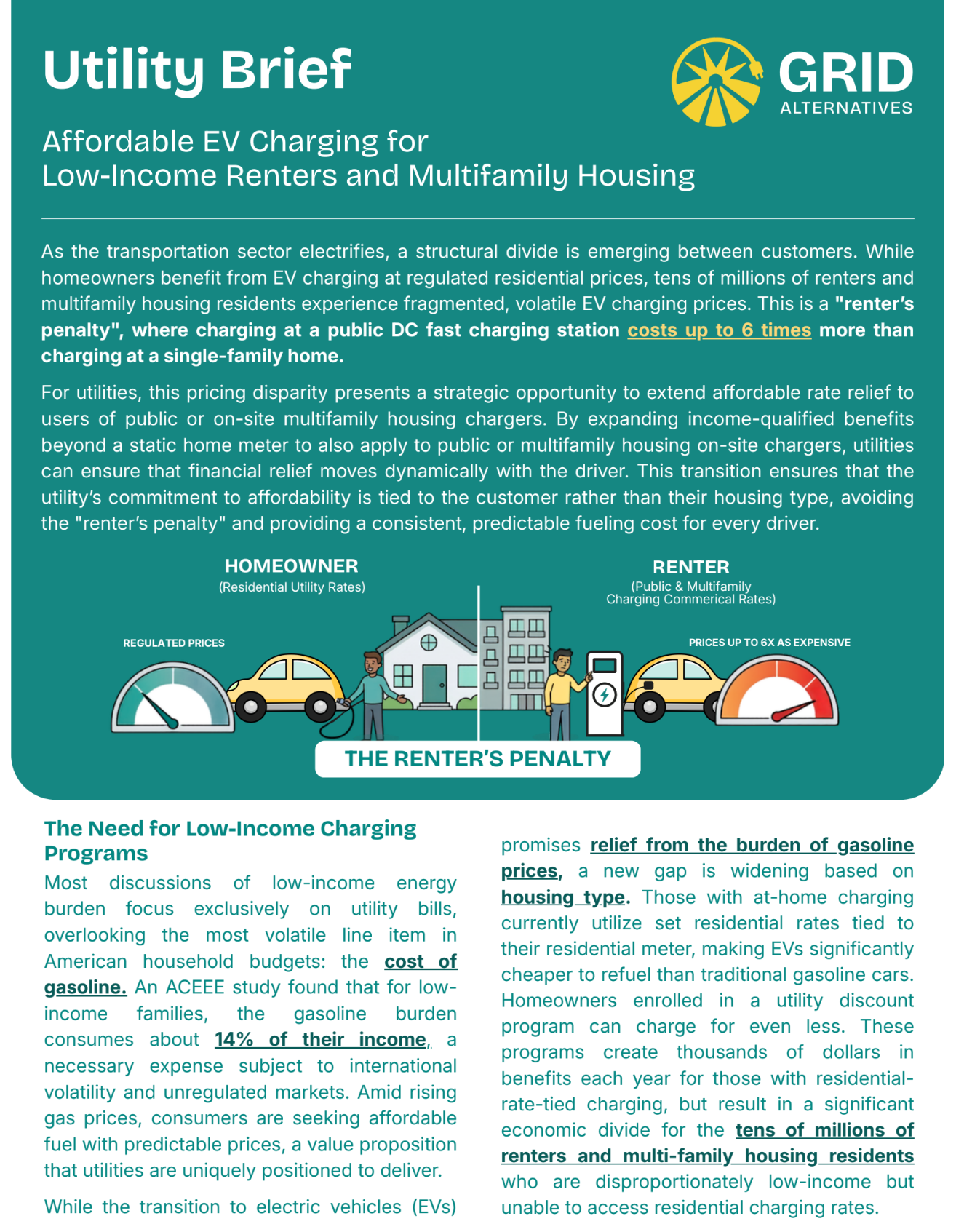
A divide is growing in the transportation electrification sector, and not just between those with EVs and those without. A financial gap is developing between homeowners who benefit from regulated residential EV charging and tens of millions of renters and multifamily housing residents who experience fragmented, volatile EV charging prices. This is a "renter’s penalty", where on-site multifamily or public charging can cost 2-6x more than charging on a standard residential meter.
For utilities, this pricing disparity presents a strategic opportunity to extend affordable rate relief to users of public or on-site multifamily housing chargers. By separating income-qualified benefits from a static home meter to then apply to public or multifamily housing on-site chargers, utilities can ensure that financial relief moves dynamically with the driver. This transition ensures that the utility’s commitment to affordability is tied to the customer’s account rather than their housing type, effectively eliminating the "renter’s penalty" and providing a consistent, predictable fueling cost for every driver.
Read our utility brief
Learn how utilities are uniquely poised to overcome affordability issues at public chargers.
The Opportunity
Electric utilities are strongly situated to deliver these benefits. Unlike gasoline retailers, utilities have longstanding universal service obligations and established low-income programs that can be expanded to cover EV chargers.
Transportation electrification allows utilities to address working families’ gasoline burden and create “the gas station of the future” with fuel all customers can afford. By extending existing low-income discount programs to public charging and multifamily housing residents, utilities can eliminate the "renter’s penalty” for EV charging, driving managed load growth from low-income drivers. Scaling these proven discount programs transforms the utility into an affordability hero, elevating a superpower that can relieve the gasoline burden.
- Statutory and Policy Compliance: Aligning new programs directly with codified state equity targets, transportation electrification mandates (TEPs), and utility commission directives.
- Grid System Optimization: Utilizing off-peak managed charging incentives to encourage low-income drivers to charge during optimal windows, improving the utility's overall system load factor and protecting distribution grid reliability.
- Mitigating Cross-Subsidization: Designing robust programs that utilize distinct funding pathways, such as Low Carbon Fuel Standard (LCFS) clean fuel credits, dedicated system benefit riders, or federal grants, to protect non-participating ratepayers.
- Supporting Low-Income Customers: Transitioning a household’s transportation energy from volatile gasoline to regulated, predictable electricity, cutting the traditional gasoline burden significantly, making tangible impacts for those who need it most.
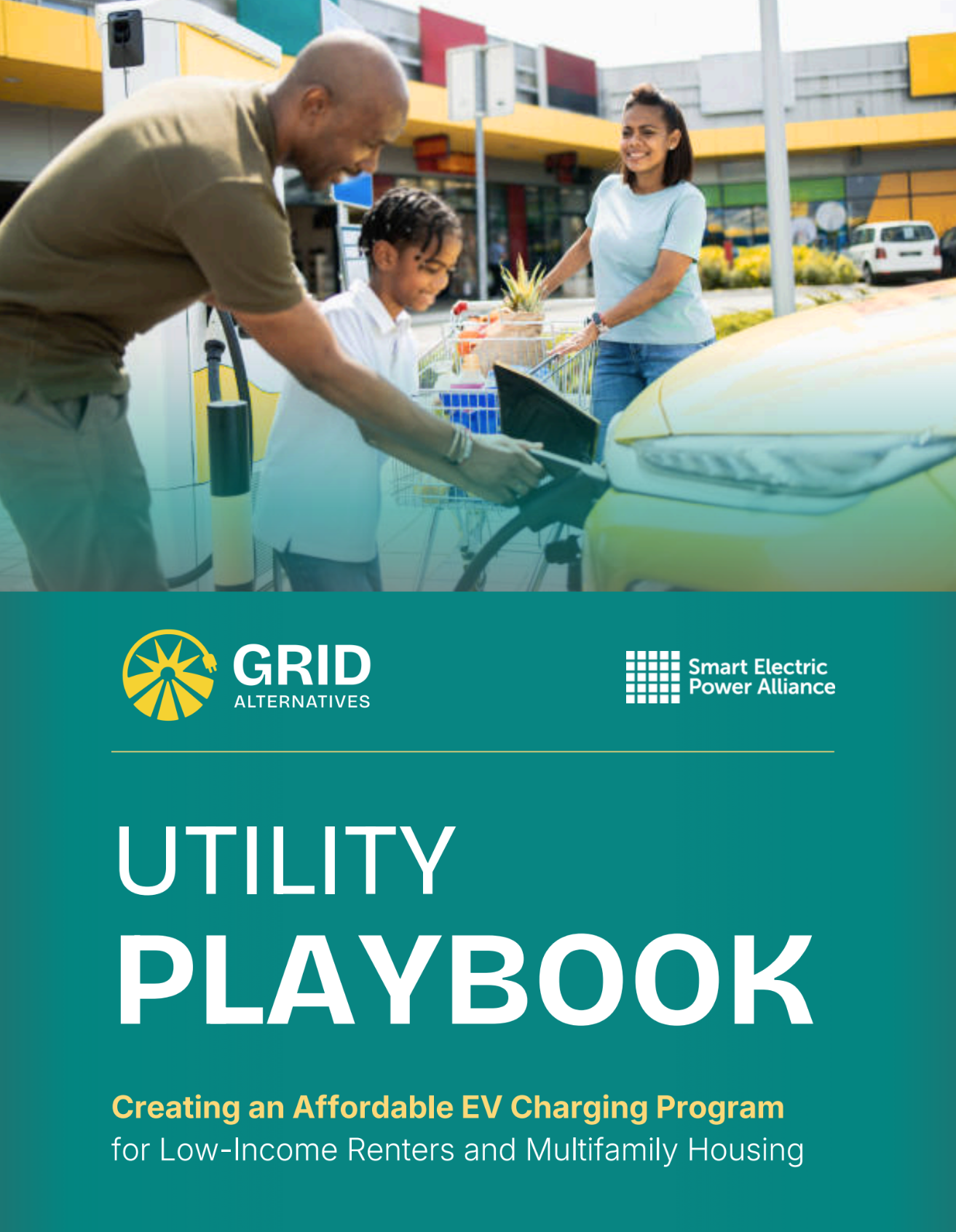
Access the Utility Playbook
Our newly released framework provides utilities and regulators with the practical steps to evaluate and build the framework for an income-qualified public charging program.
GRID Alternatives' approach to equitable clean mobility
The Challenge
- Lower-income households face the most barriers to unlocking this opportunity - in addition to the cost barriers of buying an EV, lower-income Americans disproportionately live in multifamily rental housing and lack access to low-cost, convenient home charging
- Drivers dependent on public EV charging pay 2-6 times more to “fill up”, which can erase the fuel cost savings for the very folks who need it the most (UC Institute for Transportation Studies)
- While many of these households are eligible for discounted home electric rates, they often can’t use these discounts to reduce the cost of charging since they can’t charge at home
Join the Community of Practice
The Smart Electric Power Alliance (SEPA) has partnered with GRID Alternatives to launch a Community of Practice with support from the federal Joint Office of Energy and Transportation, which will bring utilities together to share lessons learned in the equitable, EV charging space for low-income renters. Some participants will develop and launch new business models for enabling equitable access to EV charging for low-income renters while others will bring forth lessons learned and share best practices.
Who should participate? Publicly-owned utilities, investor-owned utilities, rural electric cooperatives, community choice aggregators, and LSE adjacent ecosystem partners are all invited to participate in the Community of Practice.
About the Program
GRID Alternatives is operating this program in partnership with Smart Electric Power Alliance (SEPA), Drive Clean Colorado, and EVNoire. This material is based upon work supported by the U.S. Department of Energy’s Office of Energy Efficiency and Renewable Energy (EERE) under the Joint Office of Energy and Transportation through the U.S. Department of Energy’s Office of Energy Efficiency and Renewable Energy (EERE) Award Number DE-EE0011243.
Key supporters of the project include General Motors and the Rivian Foundation.
|
|
|
|
|
|
Join the Community of Practice!
Reach out to Ashley Lynn Qua at aqua@sepapower.org for more information.
Legal Notice
The views expressed herein do not necessarily represent the views of the U.S. Department of Energy or the United States Government.