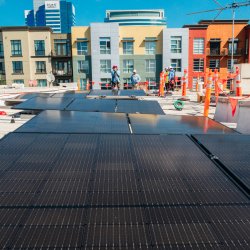
Once, not so long ago, I knew almost nothing about solar power. I knew mainly that it involved shiny black panels placed on the roofs of buildings. As a child of the 1970s, I vaguely remembered solar power being in the news back then–President Carter had solar panels installed on the roof of the White House! My personal experience with solar technology, however, began and ended with a gag gift I bought years ago for one of my sisters, a small plastic figurine of Queen Elizabeth II that waved when you placed it in sunlight, because Her Majesty had a photovoltaic cell mounted on her tiny handbag.
When I joined GRID Alternatives, I figured that I should learn at least a little about solar power. At first, I feared that this would require some remedial science lessons, but I’ve found that the basics are easy to understand—and that having some background on the science and history behind solar power helps me tell GRID’s story to people outside our organization in a more informed way.
With that, let me welcome you to the Five-Minute Solar Power University. Our lessons begin, of course, with that big glowing object in the sky…our friend, the Sun!
Astronomy Class: The Sun is the Hottest Thing in the Solar System Right Now
The Sun is a G-type yellow dwarf star in the Orion Spur of the Milky Way Galaxy. Located approximately 93 million miles from GRID headquarters in Oakland, it generates energy through the nuclear fusion of hydrogen into helium. And it generates a lot of energy: The amount that reaches Earth as sunlight every second equals 173,000 terawatts (one trillion watts), and that’s only a billionth of the total energy the Sun produces in a second.
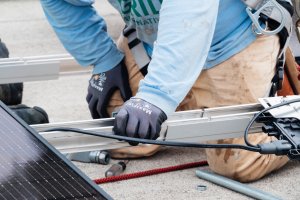
So: the Sun gives off plenty of light that human beings, such as those who work at GRID, can turn into inexpensive power! But how do we do that? To put it another way, what exactly are those panels doing up on the roof?
Physics Class: Solar Power Technology Explained in 200 Words (give or take)
Those panels are using the photovoltaic effect. Put very simply, the photovoltaic effect occurs in certain materials when they are exposed to light, causing them to produce an electrical current. In the late 19th century, physicists and inventors realized that the photovoltaic effect might be used to create power for newfangled contraptions such as “refrigerators” and “toasters.” Charles Fritts, who built the very first solar cell—a fancy one, made of gold-coated selenium—in 1883, thought that solar might soon compete with coal-fired power plants, which Thomas Edison had only begun building in 1882. (We’re working on it, Mr. Fritts.)
Those early solar cells may have been fancy, but they could only convert a tiny percentage of the sunlight they absorbed into electricity. In the 1950s, scientists at Bell Laboratories created a much more efficient solar cell based on silicon—the type we still use today. Mounted together on panels, these silicon solar cells could generate useful amounts of electricity, making solar power feasible for the first time.
Early on, though, solar was used for specialized purposes like powering satellites or isolated off-grid buildings. Rooftop solar as we know it didn’t really emerge until the 1970s—and all it took to really get it rolling was a worldwide crisis in the energy market.
History Class: Solar Power...not just another crazy 70s fad
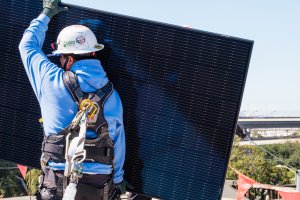
Despite what kids today might think, the decade of the 1970s wasn’t all fun stuff like leisure suits, Pet Rocks, and roller disco. The Seventies also had economic upheavals like the 1973 oil crisis, when oil-producing countries in the Middle East briefly stopped exporting to the United States. Oil prices tripled, energy costs skyrocketed, and Americans started thinking about alternative power sources, including solar energy. The federal government invested in research and development, and the IRS began issuing tax credits for home solar installations. Though government support for clean energy has fluctuated since then—President Reagan had those solar panels President Carter put on the White House taken down, for example—the solar market has continued to grow.
Economics Class: Everything Old is New Again
By now, you may be asking: “But, Ted, what do selenium cells or the 1973 oil crisis have to do with GRID today?” Probably not much! Still, it’s interesting to compare those past events to conditions today.
Right now, just as in the mid-seventies, the world is facing higher fossil fuel costs due to war in the Middle East. Electricity costs are rising. Climate change is driving extreme weather events that place stress on power grids. The political weather has also been extreme, with sudden policy shifts and major cuts to federal funding for clean energy projects—yet renewables are still very much in demand.
According to the Solar Energy Industries Association (SEIA), solar and battery storage systems accounted for 91 percent of the new electricity-generating capacity installed in the first quarter of 2026. As a nonprofit in solar, GRID is bringing this industry-leading, cutting-edge capacity to the communities that need it most, helping them overcome the challenges of high costs and energy instability.
In Conclusion:
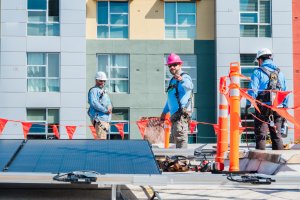
The residents of environmental justice communities and Tribal nations, the people GRID serves, need safe, reliable, non-polluting energy, not to mention the downstream benefits like jobs in clean energy, local economic growth, and energy independence. At GRID, we bring them those benefits by connecting them with that bright object in the sky.
Or at least that’s one way of looking at it. Congratulations–you are now a graduate of Five-Minute Solar Power University! Please don’t get carried away celebrating.
Author Bio:

Ted Downum is Senior Grant Writer, Foundations, for GRID HQ’s Philanthropy and Communications Department. A graduate of the University of Kansas and Regis University, he lives in Denver, Colorado.